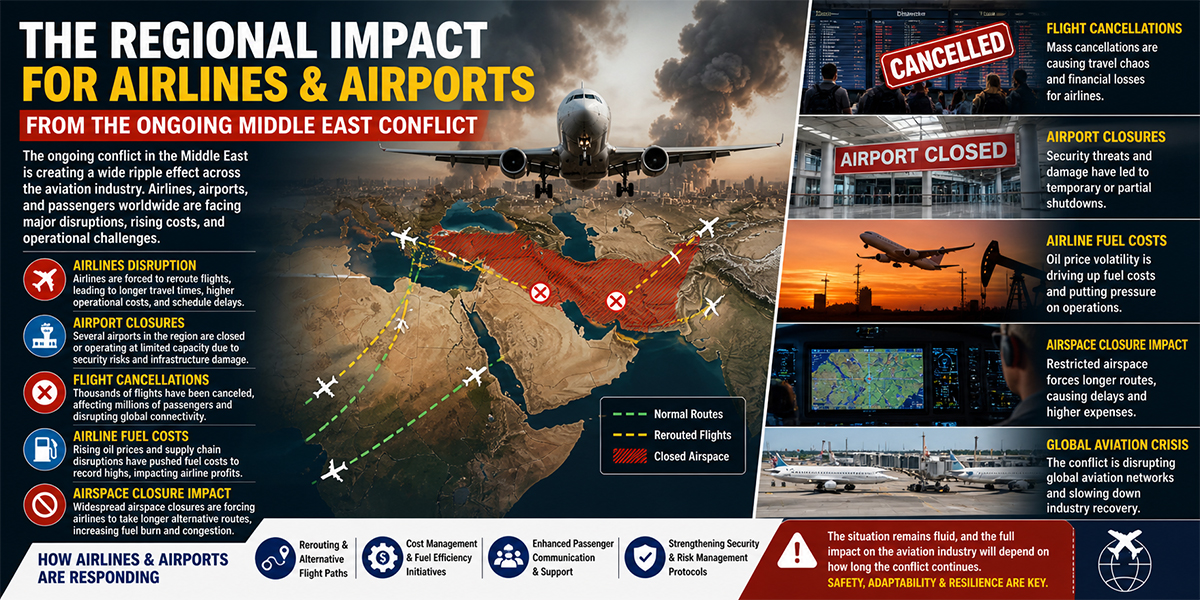

The aviation industry is experiencing a significant transformation due to ongoing geopolitical tensions in the Middle East. This situation has created a massive Middle East aviation impact affecting airlines, airports and global travel networks. As the region serves as a crucial link between Europe, Asia and Africa disruptions here quickly escalate into a wider global aviation crisis.
From airlines disruption and airport closures to rising airline fuel costs, flight cancellations and serious airspace closure impact the aviation ecosystem is under immense pressure. This blog explores the depth of these challenges and how they are reshaping the future of global aviation.
Understanding the Middle East Aviation Impact
The Middle East has long been a strategic aviation hub. Airlines rely heavily on this region for connecting long-haul flights across continents. However, ongoing conflict has disrupted this network, causing delays, uncertainty and increased operational risks.
The Middle East aviation impact is evident in restricted airspace, rerouted flights and reduced capacity. Airlines are now forced to operate under constantly changing conditions, making planning and scheduling more complex than ever before.
Airlines Disruption: A Growing Challenge
One of the most immediate effects of the crisis is widespread airlines disruption. Airlines are having to reroute flights to avoid unsafe airspace, often adding several hours to journey times.
This disruption is causing:
-
Longer flight durations
-
Increased fuel consumption
-
Higher crew and maintenance costs
-
Delays and scheduling conflicts
Passengers are experiencing inconvenience through delays, missed connections and higher ticket prices. Airlines on the other hand are struggling to maintain efficiency while ensuring safety.
Airport Closures and Infrastructure Strain
The rise in airport closures is another major consequence of the conflict. Airports in high-risk areas have either suspended operations or are functioning at limited capacity.
Airport closures lead to:
-
Diversion of flights to alternative locations
-
Increased congestion at nearby airports
-
Delays in arrivals and departures
-
Strain on airport infrastructure and staff
Even airports outside the Middle East are feeling the pressure as rerouted flights increase traffic, creating bottlenecks and operational challenges.
Flight Cancellations Disrupt Global Travel
The crisis has led to a sharp increase in flight cancellations affecting millions of passengers worldwide. Airlines are canceling routes that pass through conflict zones or are no longer economically viable due to rising costs.
For travelers, this results in:
-
Sudden itinerary changes
-
Increased waiting times
-
Limited alternative flight options
Flight cancellations also disrupt cargo operations, affecting industries that rely on timely delivery of goods. From pharmaceuticals to e-commerce supply chains are being impacted globally.
Rising Airline Fuel Costs and Economic Pressure
A critical factor contributing to the global aviation crisis is the surge in airline fuel costs. The Middle East is a key oil-producing region, and geopolitical instability has led to volatile fuel prices.
Rising fuel costs are forcing airlines to:
-
Increase ticket fares
-
Reduce flight frequency
-
Retire older, less efficient aircraft
-
Focus on fuel-efficient operations
These changes are making air travel more expensive, impacting both leisure and business travelers.
Airspace Closure Impact on Global Aviation
The airspace closure impact is perhaps the most significant operational challenge. With several airspaces restricted or closed airlines must rely on limited alternative routes.
This leads to:
-
Congestion in safe air corridors
-
Increased flight times
-
Higher fuel consumption
-
Reduced operational efficiency
The situation demonstrates how interconnected global aviation is. A disruption in one region can have far-reaching consequences worldwide.
Broader Global Aviation Crisis
The combined effects of airlines disruption, airport closures, flight cancellations, airline fuel costs and airspace closure impact have resulted in a full-scale global aviation crisis.
Airlines are facing financial pressure due to:
-
Increased operational costs
-
Reduced passenger demand on affected routes
-
Compensation claims from delays and cancellations
Airports, especially smaller ones, are struggling with reduced traffic and financial instability. The entire aviation ecosystem from ground handling to logistics is under strain.
Impact on Passenger Confidence and Travel Demand
Another critical aspect of the crisis is its effect on passenger behavior. Travelers are becoming more cautious, avoiding routes that pass through or near conflict zones.
This has led to:
-
Reduced bookings for certain international routes
-
Increased demand for alternative travel paths
-
A shift in tourism trends
While global travel demand remains steady overall, growth has slowed due to uncertainty.
Long-Term Implications for the Aviation Industry
The ongoing situation is likely to have lasting effects on the aviation industry. Some key long-term changes include:
1. Route Diversification
Airlines may permanently redesign routes to avoid conflict-prone regions.
2. Focus on Fuel Efficiency
There will be increased investment in fuel-efficient aircraft and sustainable aviation technologies.
3. Emergence of New Aviation Hubs
Regions outside the Middle East may gain importance as alternative transit hubs.
4. Industry Consolidation
Financial pressure may lead to mergers, partnerships, or closures of weaker airlines.
How Airlines and Airports Are Adapting
Despite the challenges, the aviation industry is actively adapting to the crisis. Airlines and airports are implementing several strategies:
-
Using advanced route planning technology
-
Increasing communication with passengers
-
Enhancing safety protocols
-
Optimizing fleet usage
These measures are helping maintain operations while minimizing disruption.
Conclusion
The ongoing conflict has created a significant Middle East aviation impact leading to widespread airlines disruption, airport closures and flight cancellations. Combined with rising airline fuel costs and severe airspace closure impact the aviation industry is facing one of its most challenging periods in recent history.
This global aviation crisis highlights the vulnerability of interconnected travel networks and the importance of adaptability. While the situation continues to evolve airlines and airports are working to navigate these challenges and ensure the safety and continuity of global air travel.
For travelers, staying informed, flexible and prepared is essential in managing travel plans during this uncertain time.


By Alison Bernard
Published May 05,2026